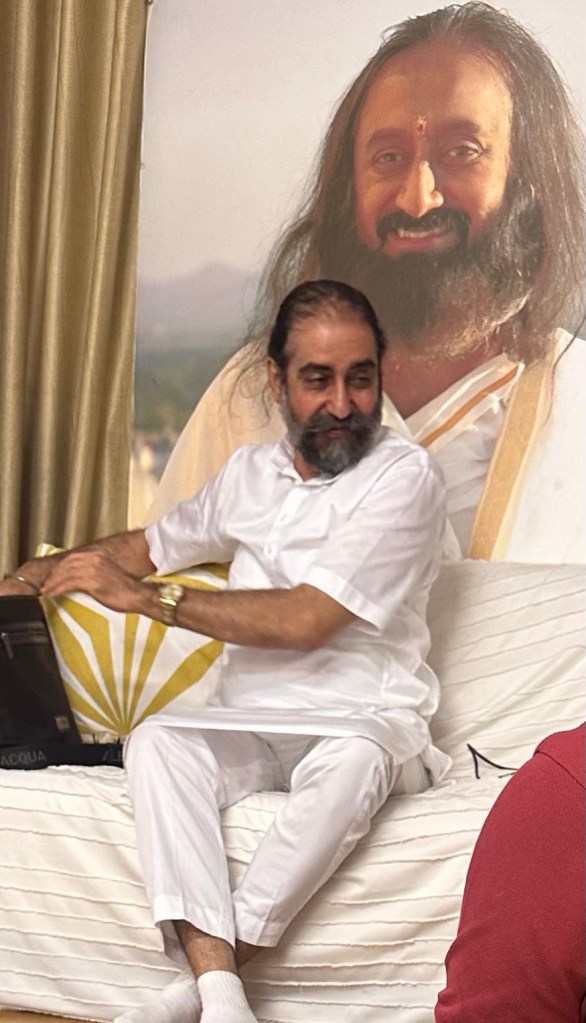
Reflections from a morning of questions, laughter and wisdom with Balwinder ji
To the uninitiated, meditation may seem like another pursuit to get something viz. more joy, mental clarity, emotional stability, efficiency, or productivity.
Yet meditation is none of these.
Meditation is merely the act of becoming a witness to what is.
Balwinder ji recently conducted a session for teachers here in Singapore and, in his inimitable humorous style, responded to a wide range of questions from the audience. While the topics varied, they all seemed to point towards the same truth – moving from doing to being, from identification to witnessing.
Here are some reflections that stayed with me.
What is Surrender?
Surrender is not a doing.
When you feel a deep sense of oneness with someone or something, surrender happens automatically. In fact, surrender without oneness is not possible. It is merely a pretence, often accompanied by an expectation of getting something in return.
You do not consciously decide to surrender to your mother or father. It simply is.
Balwinder ji humorously added that someone who is not humble but falls at your feet can be dangerous. Who knows? He may be pulling the rug from under you.
What are the Parameters of Happiness?
Happiness is being at peace.
When you feel truly rested, you feel happy.
Interestingly, the body never really rests. When the body stops functioning, we call that death. The mind too is constantly active.
Yet when we can simply witness everything that is happening without resistance, there is a natural ease. In that moment, we feel good.
How Should We Communicate?
Plan with the intellect.
Communicate with belongingness.
Simple, yet profound.
How Do We Overcome Cravings and Aversions?
The moment we stop identifying with cravings and aversions as “me,” something shifts.
Cravings and aversions are merely tendencies of the mind. The mind clings to experiences that brought pleasure and tries to avoid experiences that brought pain.
The moment we recognise this mechanism and witness it, we have already stepped away from it.
Why is Humour Important?
“Who goes to a hospital?” Balwinder ji asked.
“The one who is serious!”
The room erupted in laughter.
Life itself is rather absurd. We arrived here without our permission and one day we will leave without our permission. Every moment is a step towards death.
Why then take life so seriously?
It is far better to laugh at this beautiful stupidity called life.
How Do We Get Rid of Doership?
It is the ego that keeps insisting, “I am doing.”
Do we do anything to digest our food?
Do we consciously keep our heart beating?
When we begin to recognise that there is an intelligence far greater than us sustaining life, we realise that much of what we call “doing” is simply happening.
Even the moments when we think we are consciously acting are happening within a much larger process.
Doership tires the body and exhausts the mind.
Being a witness creates a separation between ourselves and the event.
Why is Silence Important?
Through speech, we expend prana.
Prana is the life force sustaining everything within us.
A baby takes well over a year before it begins speaking. During that time, prana is building and organising itself to express through language.
Silence allows us to restore and conserve this precious energy.
Periods of silence leave us feeling nourished in ways that words cannot.
Why is Asking Questions Important?
When we do not ask questions, we often spend a long time moving from knowledge to understanding.
A sincere question shortens that journey.
Why Become a Teacher?
When you experience, you learn.
When you share, you learn even more.
Teaching is one of the most powerful ways of moving knowledge into understanding.
Balwinder ji remarked that if Gurudev had waited for everyone to fully understand before making them teachers, there would be no teachers.
Teaching itself becomes part of the learning process.
What is Leadership?
Leadership is an act of sacrifice.
Balwinder ji reflected on how Gurudev continually sacrifices his own comfort, time, and even his state of bliss to listen to the problems, worries, and negativity of countless people.
Leadership is not merely influence.
It is sacrifice born out of love and responsibility.
How Often Should We Do the Advanced Meditation Course?
Balwinder ji encouraged us to do the Advanced Meditation Course at least four times a year in today’s environment.
The AMC is not merely a retreat.
It is a repeated journey into witnessing.
Again and again we are reminded:
“I am not the mind.”
“I am not the body.”
“Asangoham. Asangoham. Punaha Punaha.”
He shared a humorous example.
“When my dentist asks me how I am, I tell him I am mast.”
Then the dentist asks, “But isn’t your tooth hurting?”
“Yes,” says Balwinder ji, “the tooth is hurting. But I am mast.”
The tooth may hurt.
The boss may be difficult.
Circumstances may be unpleasant.
But I am not the tooth.
I am not the situation.
To experience this state of witness consciousness requires prana. This is why pranayama is so important. And this is why returning to the AMC again and again helps transform knowledge into lived understanding, not intellectually but experientially.
Conclusion
As I reflected on the session, it struck me that almost every answer pointed in the same direction.
The moment we stop identifying with everything happening within and around us, a certain freedom becomes available.
Meditation is not about gaining something new.
It is simply a reminder of what we already are.
A witness to it all.

